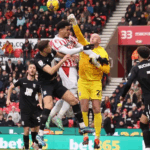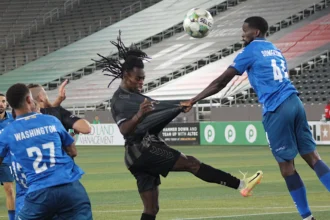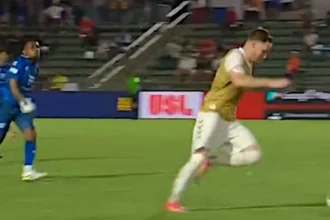
One of the key moments in the Tulsa game this past weekend was, obviously enough, the handball called on Jackson Travis late in the first half. Late being, in this case, exactly 51 minutes, which was right as the announced 6 minutes of added time expired (although that is always a minimum, not a fixed number). The resulting penalty gave Tulsa a lead going into half-time and, ironically, energized the Three Sparks into an excellent second half which came very close to a win.
The event gives rise to a couple of questions. First, was it actually a handball? Second, if it was, should it have been called?
The answer to the first question is: it depends.
The International Football Association Board (IFAB) is the entity responsible for maintaining the Laws of the Game. There are several laws which receive frequent updates. One is offside, handball is another. For the most part, the updates just make things even more confusing than they already were.
The handball law as written is not very helpful and in fact is interpreted in varying ways across the globe. The law is part of Law 12 and the relevant section reads as follows:
For purposes of determining handball offences, the upper boundary of the arm is in line with the bottom of the armpit. Not every touch of a player’s hand/arm with the ball is an offence.
It is an offence if a player:
- deliberately touches the ball with their hand/arm, for example moving the hand/arm towards the ball
- touches the ball with their hand/arm when it has made their body unnaturally bigger. A player is considered to have made their body unnaturally bigger when the position of their hand/arm is not a consequence of, or justifiable by, the player’s body movement for that specific situation. By having their hand/arm in such a position, the player takes a risk of their hand/arm being hit by the ball and being penalized
There’s also a very silly graphic in the Laws designed to indicate what constitutes a handball but it is entirely useless.
So, to start off, it is possible for contact between arm and ball not to be judged a handball. For example, this relatively recent and already notorious incident was not called a handball:
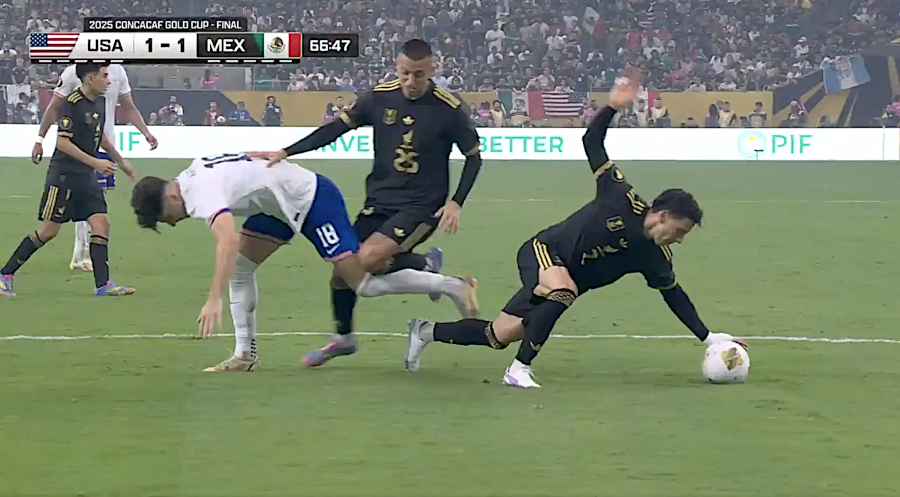
Yeah, right. And the apparent foul on Max Arfsten wasn’t called either. Generally speaking, if a player gains an advantage from inadvertent contact, as was the case here, it will be called for a handball. Falling on the ball is one thing, but to clearly control it with the hand is entirely another even if the initial touch was accidental. But that alone places quite a burden on the officials and they are not going to be in universal agreement on any one situation.
Note, however, that there is nothing in the law about “ball to hand.” This is a common misconception that gives rise to all sorts of arguments. Probably quite intentionally on the part of IFAB. Nothing quite like a spirited debate to keep interest up (especially if fueled by alcohol). But the crux of the matter is that unintentional contact can be deemed handball. And this is where things start to get tricky as regards this past Saturday evening.
The first bullet point in the law does not apply here, as Jackson clearly was not intending to touch the ball. The second bullet is intended to define other instances of handball but is fraught with difficulties. For one thing, what the [insert preferred cussword here] does “unnaturally bigger’ mean?
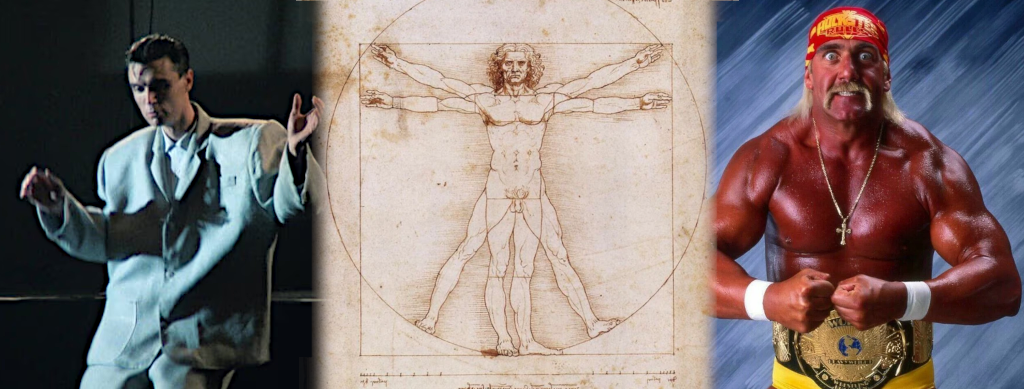
The human body is, in and of itself, an entirely natural object. It cannot be made bigger than it is. Well, perhaps with steroids, but that’s another issue. Regardless of how the body is deployed, it is the same size. It occupies a defined volume of space that cannot be changed. Granted, waving an arm about increases the body’s reach beyond a more normal posture, but still. We’re all Vitruvian Man after all. If we are going to make ourselves unnaturally bigger we need David Byrne’s suit or Hulk Hogan’s supplier.
Worse, the law even says that arm position due to normal movement is entirely expected and acceptable. Which imposes even more judgment calls on the referees. One specific situation that has been declared justifiable by IFAB is putting an arm down for support when sliding. But what about the other arm when sliding? Does that not also contribute to the player’s balance when sliding? That is what Jackson was evidently doing in this case. I submit that this was fully a consequence of his body movement.
Ironically, this part of the law often causes defenders to put their arms in what I would consider unnatural positions. Specifically, you often see them clasp their hands behind their backs in a clear attempt reduce the chance of contact. But this makes it much more difficult to balance and move and is in some ways contrary to the spirit of the game. Moreover, it could be argued that if the ball hits the arm it’s a handball anyway purely because the position is not natural.
So, just from the way the law is constituted, Jackson’s action is questionable as a handball. He in fact argued that the ball hit him on his upper torso, not the arm. Replays showed that it probably did hit his arm, although the whole sequence was so fast as to make it difficult to determine without seriously slowed video.
That leads to the second question: could the referees even make the call? Neither the center ref nor the assistant ref were in position to make a determination, especially not at full speed. Indeed, the AR signaled for a corner. The center ref was behind the play and possibly had his line of sight obscured by other players:
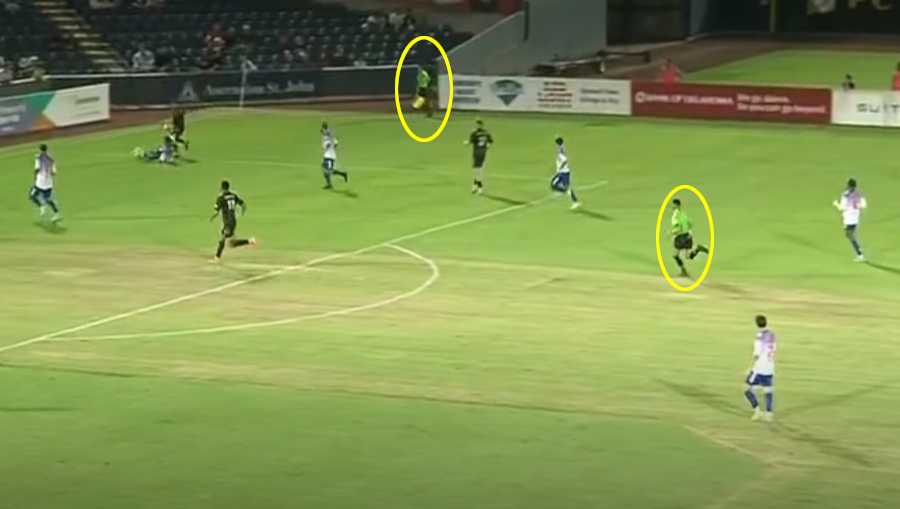
No way did either of them have a good view of that play. The center ref stated that he conferred with the AR and also with the 4th official before making the ultimate decision. I don’t see how the 4th official could add any value to the discussion as he would have been so far from the play and at such an angle as to have no way to see what happened. The Legion bench were entirely convinced that the stadium video board was party to the decision, which of course is utterly out of bounds. The video board at ONEOK Field is behind the outfield bleachers, which are behind the AR in the shot above. Easily in the center ref’s field of view and near impossible to ignore.
The ref apparently denied this was the case. If the stadium feed was the same as the broadcast then one replay angle was shown before the penalty decision was given. It wasn’t the best angle but did seem to show the ball hitting Jackson’s arm. Still, it should not have been shown and that is on Tulsa. I am fairly confident that at Protective Stadium such incidents are not replayed, at least not until after play has restarted and the decision is fixed. Whether the ref looked at the replay or not, it certainly raised the possibility that he did and put him in a very difficult position. A better replay was shown a bit later, which was from a goal-line camera right in line with the play and gave a much clearer view of the play. But the decision was already made at that point.
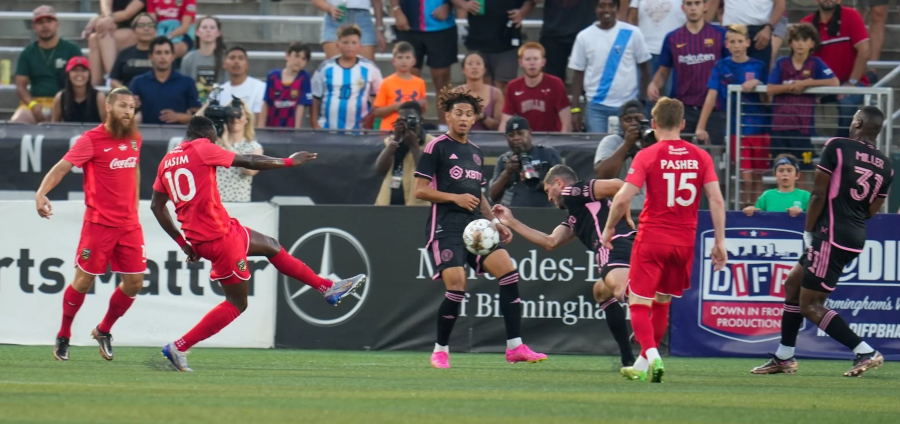
So the handball was questionable for two reasons: it’s not clear the law deems the play a handball and even if it does it couldn’t have been seen properly anyway. Unlike a certain other incident that was clearly visible:
Update:
I spoke with Mark Briggs today. Here’s what he had to say: “I’m 100%, 150% positive that the referee looked at the board and watched the video replay and then gave the decision. And the reason I’m that, like, positive on it is because they didn’t know what to do. Every single official froze…I have a call with the head of referees today to discuss this decision because I want to be explained to about this decision.” As to the replay even being up: “They were smart, they were clever, you know. But it’s illegal.” He was not happy.